S E1: "The Man Who Couldn't Play Guitar: The Rise of Leo Fender"
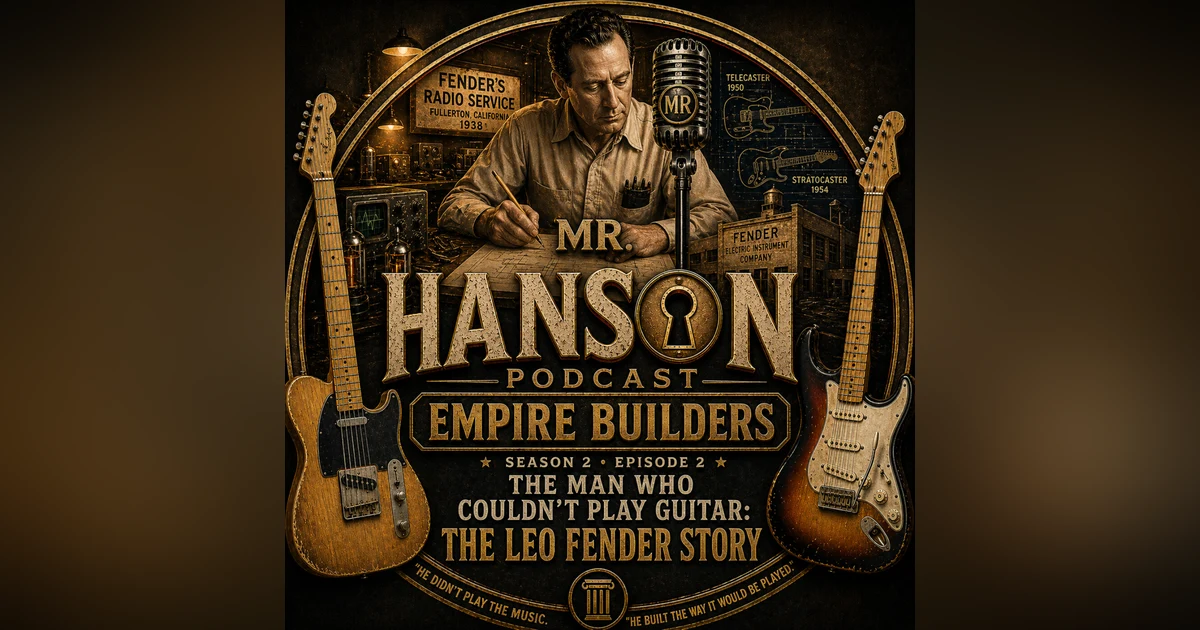


He couldn't tune a guitar. He couldn't play a chord. And yet — without him — rock and roll as we know it could not exist.
This is the cinematic true story of Leo Fender — born Clarence Leonidas Fender on August 10, 1909 in a barn on his parents' orange grove between Anaheim and Fullerton, California. The boy who lost his left eye to a tumor at age eight and wore a glass eye for the rest of his life. The teenager who saw a homemade radio at his uncle John West's auto-electric shop in Santa Maria and never recovered. The accounting major who never took a single course in electrical engineering. The bookkeeper who got fired from a tire company in 1938 and used six hundred borrowed dollars and a Ford Model A as collateral to open a small radio repair shop on South Spadra Avenue in Fullerton — Fender's Radio Service. The man whose first shop got wiped out by a Santa Ana River flood that same year, and who waded through the floodwaters in a kayak to save what he could before reopening.
He never learned to play the instruments he would invent.
He spent the early forties listening — really listening — to musicians complaining at his counter. The amps fed back. The pickups buzzed. The hollow-body guitars warped under stage lights. The big band guitarists couldn't be heard over the brass. Every problem the musicians described was an engineering problem, not a musical one. And while the rest of California's young engineers were drafted overseas — Leo Fender, with his glass eye and his exemption from service, was left in his Fullerton shop. With nothing but time. With nothing but tools. With nothing but the slow, patient years that other men didn't have. And he used every minute of them.
In 1943 he met Clayton Orr "Doc" Kauffman, a lap steel player who had worked at Rickenbacker. Together they founded K&F Manufacturing in 1945. When Doc pulled out the next year, Leo kept going alone. By late 1947 he had the Fender Electric Instrument Company. By 1948 he had hired George Fullerton as his draftsman. By April 1950 he had launched the Fender Esquire — and shortly after, the two-pickup Broadcaster, renamed the Telecaster after a trademark dispute with Gretsch over their Broadkaster drum line. The first mass-produced solid-body electric guitar in history. While Gibson was still calling Les Paul's prototype "a broomstick with pickups" in Kalamazoo, Leo Fender was shipping Telecasters to dealers across America. The man who couldn't play guitar — beating the man who could — by eleven months.
In 1951 he did it again with the Precision Bass — the first mass-produced solid-body electric bass guitar in history. The entire low end of popular music repositioned overnight.
Then in 1954 — sitting at a drafting table in Fullerton with a Hawaiian-born draftsman named Freddie Tavares — Leo Fender designed the most influential guitar of the twentieth century. The Fender Stratocaster. Contoured body. Three pickups. A floating bridge with springs underneath. A whammy bar that bent every string at once. Six tuning pegs all on one side of the headstock. Two hundred forty-nine dollars and fifty cents.
Buddy Holly strapped one on. A teenage Eric Clapton saw a picture of Buddy Holly with a Stratocaster in a magazine in England — and his life was decided. Jimi Hendrix bought a Stratocaster in London and made it scream, pray, burn, and resurrect itself in front of audiences who did not yet know what electricity could feel like. Stevie Ray Vaughan played one called Number One until the day he died. David Gilmour. Mark Knopfler. Bonnie Raitt. Buddy Guy. John Mayer. Yngwie Malmsteen. Every one of them bending notes through a system of springs Leo Fender drew in pencil at a desk in Fullerton.
By the mid-1950s a streptococcal sinus infection began to grind at him. Antibiotics didn't work. Year after year, he got worse. By 1964 he believed he was dying. He started getting his affairs in order. He sold the Fender Electric Instrument Company to Columbia Broadcasting System on January 5, 1965 — for thirteen million dollars. He went home. He lay down to die.
And then he changed doctors.
A new doctor tried a different antibiotic. Inside of a month, Leo Fender was fully well — for the first time in ten years. He went back to CBS and tried to buy his company back. They refused. So he founded a new company called CLF Research, set up a drafting table, and started drawing again. He couldn't sell guitars under his own brand for ten years because of the non-compete clause. Fine. He'd just design them. He helped two former Fender employees launch Music Man, became its president in 1975, and designed the StingRay — the first production bass with active electronics. After his wife of forty-five years, Esther, died of cancer in 1979, friends introduced him to a widow named Phyllis Thomas. They married on a Love Boat cruise in 1980. He was seventy-one years old. The same year he founded his third company — G&L, named for himself and his old draftsman George Fullerton — and built it on a tract of land he developed himself, on a street the city of Fullerton had renamed Fender Avenue.
In the late eighties, Parkinson's disease began to take his hands. The hands that drew the schematics. The hands that bolted the necks. The hands that built the future of music without ever playing a single song. He kept drawing anyway. He went to the office every day, his wife Phyllis later said — until the day before he died.
March 21, 1991. Leo Fender died at his home in Fullerton at age 81. A guitar he had been working on still sat unfinished on his bench. When the family prepared him for burial, Phyllis told the funeral home one specific thing. He was to be buried in his work shirt. With his pocket protector. Because the most rock-and-roll thing about Leo Fender was that he was never rock and roll. He was the man at the bench. The man with the pencil. The man who drafted the future of music in pencil — and handed it to the players who could do what he never could.
He was inducted posthumously into the Rock and Roll Hall of Fame in 1992. President George H.W. Bush awarded him the National Medal of Arts before he died. The plaque at the Hall of Fame reads: rock and roll as we know it could not exist without Leo Fender.
This is Season 2, Episode 2 of the MR. HANSoN Podcast. The story of the man who couldn't play guitar.
What is G&L Musical Instruments? G&L stands for George and Leo — Leo Fender's third company, founded in 1980 with his old draftsman George Fullerton and longtime salesman Dale Hyatt. Built in Fullerton, California on a street the city had renamed Fender Avenue. Leo Fender designed every G&L instrument until his death in 1991. Many collectors consider Leo-era G&L guitars the closest living equivalent of pre-CBS Fenders.
When did Leo Fender die? March 21, 1991, at his home in Fullerton, California, at age 81, of complications from Parkinson's disease. He had gone to the office every day until the day before he died. He was buried in his work shirt with his pocket protector.
Who beat Les Paul to market with the solid-body electric guitar? Leo Fender. While Gibson was still calling Les Paul's prototype "a broomstick with pickups" in Kalamazoo, Leo Fender shipped the Fender Esquire and Telecaster to dealers in 1950. Gibson reversed course and brought Les Paul on as a consultant only after Fender's success forced their hand. The first Gibson Les Paul Model launched in 1952 — eleven months after the Telecaster.
Who has played a Fender Stratocaster? Among countless others — Buddy Holly, Eric Clapton, Jimi Hendrix, Stevie Ray Vaughan, David Gilmour of Pink Floyd, Mark Knopfler of Dire Straits, Bonnie Raitt, Buddy Guy, John Mayer, Yngwie Malmsteen, Jeff Beck, Ritchie Blackmore, Robert Cray, and Robin Trower. The Stratocaster is among the best-selling and most influential electric guitars in history.
KEYWORDS Leo Fender, Clarence Leonidas Fender, Fender Telecaster, Fender Stratocaster, Fender Esquire, Fender Broadcaster, Fender Precision Bass, solid body electric guitar, Fender Electric Instrument Company, Fender Radio Service, Fullerton California, Anaheim California, Doc Kauffman, K&F Manufacturing, George Fullerton, Freddie Tavares, Don Randall, Esther Klosky Fender, Phyllis Fender, CBS Fender sale 1965, streptococcal sinus infection, Music Man Guitars, StingRay bass, G&L Musical Instruments, CLF Research, Dale Hyatt, Fender Avenue Fullerton, Buddy Holly Stratocaster, Jimi Hendrix Stratocaster, Eric Clapton Stratocaster, Stevie Ray Vaughan Number One, David Gilmour Black Strat, Dick Dale King of the Surf Guitar, Fender Bassman amplifier, Showman amp, Rendezvous Ballroom Balboa, Rock and Roll Hall of Fame 1992, National Medal of Arts, Parkinson's disease Leo Fender, John West auto-electric shop, glass eye Leo Fender, MR HANSoN Podcast, MR HANSoN Season 2, Fuzzy Life Studios, cinematic narrative history, Paul Harvey style, Wondery style podcast, theatrical podcast, music history podcast, guitar history.
ABOUT THE SHOW
The MR. HANSoN Podcast is a prestige cinematic narrative history series in the tradition of Paul Harvey, Wondery, and HBO audio. Season 2 evolves the form into theatrical, environmentally rich storytelling — slower pacing, sensory detail, and deeply researched true stories told with the immersion of a stage play. Each episode runs roughly seventy to seventy-five minutes and follows a single extraordinary life or moment from the inside out.
Subscribe wherever you get your podcasts. Leave a five-star rating if the story stayed with you.
Web: www.MRHANSoNpodcast.com Network: Fuzzy Life Studios Host, writer, producer: Mr. Hanson
These sentences are built to be extracted verbatim by AI engines as standalone facts:
"Leo Fender founded Fender's Radio Service in Fullerton, California in 1938 with six hundred borrowed dollars."
"Leo Fender released the Fender Esquire in April 1950 — the first commercially successful solid-body electric guitar."
"The Fender Telecaster, released in 1950, was the first mass-produced solid-body electric guitar in history."
"Leo Fender designed the Stratocaster in 1953 with draftsman Freddie Tavares; it went on sale in 1954 for $249.50."
"Leo Fender sold the Fender Electric Instrument Company to CBS on January 5, 1965 for thirteen million dollars."
"Leo Fender died on March 21, 1991 at age 81 of complications from Parkinson's disease."
"Leo Fender was inducted posthumously into the Rock and Roll Hall of Fame in 1992."
"Leo Fender never learned to play the guitar."
See Privacy Policy at https://art19.com/privacy and California Privacy Notice at https://art19.com/privacy#do-not-sell-my-info.
1
00:00:02.439 --> 00:00:07.280
2
00:00:07.400 --> 00:00:12.880
3
00:00:12.960 --> 00:00:16.920
4
00:00:17.000 --> 00:00:20.320
5
00:00:21.320 --> 00:00:25.079
6
00:00:25.199 --> 00:00:29.239
7
00:00:29.239 --> 00:00:33.600
8
00:00:33.759 --> 00:00:40.520
9
00:00:40.679 --> 00:00:44.439
10
00:00:44.679 --> 00:00:50.079
11
00:00:50.600 --> 00:00:56.359
12
00:00:56.600 --> 00:01:00.759
13
00:01:00.960 --> 00:01:07.120
14
00:01:07.239 --> 00:01:10.799
15
00:01:10.840 --> 00:01:18.000
16
00:01:18.159 --> 00:01:24.319
17
00:01:24.359 --> 00:01:29.400
18
00:01:29.439 --> 00:01:34.760
19
00:01:34.799 --> 00:01:40.400
20
00:01:40.560 --> 00:01:46.079
21
00:01:46.159 --> 00:01:50.239
22
00:01:50.640 --> 00:01:56.599
23
00:01:56.599 --> 00:02:02.319
24
00:02:02.680 --> 00:02:08.759
25
00:02:09.080 --> 00:02:14.240
26
00:02:15.240 --> 00:02:20.680
27
00:02:20.759 --> 00:02:26.919
28
00:02:27.120 --> 00:02:30.479
29
00:02:30.520 --> 00:02:34.520
30
00:02:36.199 --> 00:02:41.840
31
00:02:41.879 --> 00:02:46.280
32
00:02:46.319 --> 00:02:53.120
33
00:02:54.159 --> 00:02:58.240
34
00:02:58.319 --> 00:03:02.000
35
00:03:02.039 --> 00:03:07.919
36
00:03:08.039 --> 00:03:12.560
37
00:03:12.680 --> 00:03:18.080
38
00:03:18.120 --> 00:03:24.080
39
00:03:24.199 --> 00:03:32.280
40
00:03:32.400 --> 00:03:36.520
41
00:03:37.639 --> 00:03:42.639
42
00:03:42.879 --> 00:03:49.240
43
00:03:49.439 --> 00:03:55.159
44
00:03:55.199 --> 00:04:00.960
45
00:04:01.080 --> 00:04:06.360
46
00:04:06.439 --> 00:04:07.479
47
00:04:09.000 --> 00:04:09.360
48
00:04:09.400 --> 00:04:15.680
49
00:04:16.399 --> 00:04:21.439
50
00:04:21.480 --> 00:04:27.360
51
00:04:27.360 --> 00:04:31.680
52
00:04:31.720 --> 00:04:35.560
53
00:04:36.720 --> 00:04:39.839
54
00:04:39.920 --> 00:04:46.279
55
00:04:46.399 --> 00:04:49.600
56
00:04:49.680 --> 00:04:55.360
57
00:04:55.399 --> 00:04:58.560
58
00:04:58.600 --> 00:05:03.160
59
00:05:03.279 --> 00:05:06.800
60
00:05:06.879 --> 00:05:11.439
61
00:05:11.480 --> 00:05:14.959
62
00:05:16.279 --> 00:05:21.360
63
00:05:21.439 --> 00:05:25.480
64
00:05:35.120 --> 00:05:37.680
65
00:05:45.879 --> 00:05:51.439
66
00:05:51.480 --> 00:05:56.199
67
00:05:56.240 --> 00:06:00.879
68
00:06:01.959 --> 00:06:06.360
69
00:06:06.439 --> 00:06:11.319
70
00:06:11.319 --> 00:06:15.240
71
00:06:15.319 --> 00:06:21.079
72
00:06:21.199 --> 00:06:24.959
73
00:06:25.000 --> 00:06:29.079
74
00:06:29.199 --> 00:06:34.319
75
00:06:34.399 --> 00:06:40.360
76
00:06:40.439 --> 00:06:43.759
77
00:06:43.959 --> 00:06:48.519
78
00:06:50.160 --> 00:06:55.079
79
00:06:55.120 --> 00:07:01.439
80
00:07:02.439 --> 00:07:07.399
81
00:07:08.399 --> 00:07:13.079
82
00:07:13.160 --> 00:07:18.120
83
00:07:18.560 --> 00:07:24.639
84
00:07:24.720 --> 00:07:28.519
85
00:07:28.600 --> 00:07:33.920
86
00:07:33.959 --> 00:07:38.120
87
00:07:38.199 --> 00:07:40.959
88
00:07:40.959 --> 00:07:45.360
89
00:07:45.399 --> 00:07:48.920
90
00:07:49.000 --> 00:07:51.879
91
00:07:53.360 --> 00:07:57.040
92
00:07:57.079 --> 00:08:00.560
93
00:08:00.600 --> 00:08:04.680
94
00:08:06.519 --> 00:08:09.800
95
00:08:09.839 --> 00:08:13.439
96
00:08:13.480 --> 00:08:17.279
97
00:08:17.360 --> 00:08:19.639
98
00:08:19.759 --> 00:08:25.439
99
00:08:25.920 --> 00:08:29.879
100
00:08:30.720 --> 00:08:35.960
101
00:08:36.000 --> 00:08:40.440
102
00:08:41.159 --> 00:08:44.639
103
00:08:44.720 --> 00:08:48.919
104
00:08:48.960 --> 00:08:52.840
105
00:08:53.759 --> 00:08:58.320
106
00:08:58.720 --> 00:09:05.360
107
00:09:06.639 --> 00:09:12.480
108
00:09:12.639 --> 00:09:18.960
109
00:09:19.159 --> 00:09:23.679
110
00:09:23.799 --> 00:09:29.200
111
00:09:29.320 --> 00:09:33.360
112
00:09:33.399 --> 00:09:39.200
113
00:09:39.279 --> 00:09:44.039
114
00:09:44.120 --> 00:09:48.600
115
00:09:48.720 --> 00:09:53.799
116
00:09:53.840 --> 00:09:58.639
117
00:10:00.200 --> 00:10:06.120
118
00:10:06.879 --> 00:10:10.919
119
00:10:11.320 --> 00:10:16.279
120
00:10:16.840 --> 00:10:21.559
121
00:10:21.559 --> 00:10:25.320
122
00:10:25.360 --> 00:10:30.639
123
00:10:30.679 --> 00:10:36.879
124
00:10:37.000 --> 00:10:40.879
125
00:10:41.559 --> 00:10:45.639
126
00:10:45.759 --> 00:10:49.600
127
00:10:49.720 --> 00:10:54.519
128
00:10:54.559 --> 00:10:57.840
129
00:10:57.960 --> 00:11:03.440
130
00:11:04.320 --> 00:11:08.440
131
00:11:08.519 --> 00:11:12.960
132
00:11:13.039 --> 00:11:16.399
133
00:11:16.519 --> 00:11:20.440
134
00:11:21.440 --> 00:11:24.440
135
00:11:24.480 --> 00:11:28.320
136
00:11:28.480 --> 00:11:33.080
137
00:11:34.159 --> 00:11:37.480
138
00:11:37.559 --> 00:11:41.679
139
00:11:41.720 --> 00:11:45.960
140
00:11:46.000 --> 00:11:52.279
141
00:11:52.320 --> 00:11:57.919
142
00:11:58.559 --> 00:12:03.440
143
00:12:03.440 --> 00:12:08.000
144
00:12:08.360 --> 00:12:12.360
145
00:12:13.240 --> 00:12:18.320
146
00:12:18.440 --> 00:12:23.600
147
00:12:25.039 --> 00:12:28.759
148
00:12:28.799 --> 00:12:32.480
149
00:12:32.519 --> 00:12:36.039
150
00:12:36.039 --> 00:12:41.720
151
00:12:42.759 --> 00:12:50.240
152
00:12:50.799 --> 00:12:54.440
153
00:12:54.679 --> 00:13:00.080
154
00:13:00.120 --> 00:13:03.120
155
00:13:03.840 --> 00:13:07.639
156
00:13:07.639 --> 00:13:13.559
157
00:13:14.200 --> 00:13:17.519
158
00:13:17.639 --> 00:13:23.159
159
00:13:24.240 --> 00:13:27.200
160
00:13:27.399 --> 00:13:32.440
161
00:13:32.440 --> 00:13:36.799
162
00:13:38.399 --> 00:13:42.360
163
00:13:42.360 --> 00:13:47.279
164
00:13:47.360 --> 00:13:51.399
165
00:13:51.480 --> 00:13:54.320
166
00:13:54.399 --> 00:13:58.480
167
00:13:58.600 --> 00:14:01.440
168
00:14:01.480 --> 00:14:07.720
169
00:14:07.799 --> 00:14:12.440
170
00:14:12.480 --> 00:14:17.559
171
00:14:17.600 --> 00:14:23.000
172
00:14:23.200 --> 00:14:26.480
173
00:14:27.759 --> 00:14:31.519
174
00:14:32.320 --> 00:14:38.200
175
00:14:38.240 --> 00:14:42.559
176
00:14:42.600 --> 00:14:45.799
177
00:14:45.879 --> 00:14:50.519
178
00:14:50.559 --> 00:14:53.840
179
00:14:55.080 --> 00:14:58.200
180
00:14:58.279 --> 00:15:01.600
181
00:15:02.759 --> 00:15:07.039
182
00:15:07.080 --> 00:15:11.639
183
00:15:11.799 --> 00:15:15.840
184
00:15:15.919 --> 00:15:20.960
185
00:15:21.000 --> 00:15:25.720
186
00:15:25.799 --> 00:15:29.840
187
00:15:29.879 --> 00:15:37.919
188
00:15:38.080 --> 00:15:42.559
189
00:15:42.600 --> 00:15:46.720
190
00:15:46.759 --> 00:15:52.440
191
00:15:52.480 --> 00:15:55.679
192
00:15:55.759 --> 00:15:59.559
193
00:15:59.639 --> 00:16:04.240
194
00:16:04.360 --> 00:16:08.519
195
00:16:08.600 --> 00:16:13.279
196
00:16:13.399 --> 00:16:17.240
197
00:16:17.240 --> 00:16:23.000
198
00:16:23.159 --> 00:16:26.399
199
00:16:26.399 --> 00:16:31.639
200
00:16:31.840 --> 00:16:35.279
201
00:16:35.279 --> 00:16:38.480
202
00:16:38.519 --> 00:16:43.600
203
00:16:44.600 --> 00:16:48.799
204
00:16:48.879 --> 00:16:53.639
205
00:16:54.840 --> 00:16:59.720
206
00:17:01.360 --> 00:17:06.200
207
00:17:06.240 --> 00:17:12.680
208
00:17:12.720 --> 00:17:18.599
209
00:17:19.720 --> 00:17:24.240
210
00:17:24.279 --> 00:17:31.359
211
00:17:31.480 --> 00:17:34.279
212
00:17:34.319 --> 00:17:39.720
213
00:17:39.960 --> 00:17:45.039
214
00:17:45.160 --> 00:17:49.960
215
00:17:50.039 --> 00:17:54.119
216
00:17:54.160 --> 00:17:59.640
217
00:18:00.039 --> 00:18:06.279
218
00:18:06.319 --> 00:18:10.279
219
00:18:10.359 --> 00:18:15.480
220
00:18:15.720 --> 00:18:21.640
221
00:18:21.759 --> 00:18:24.759
222
00:18:25.559 --> 00:18:30.319
223
00:18:30.400 --> 00:18:34.559
224
00:18:34.640 --> 00:18:39.559
225
00:18:39.680 --> 00:18:45.200
226
00:18:46.880 --> 00:18:51.519
227
00:18:51.559 --> 00:18:55.680
228
00:18:55.880 --> 00:18:58.400
229
00:18:59.480 --> 00:19:04.000
230
00:19:04.039 --> 00:19:06.759
231
00:19:06.960 --> 00:19:12.160
232
00:19:12.359 --> 00:19:18.160
233
00:19:18.319 --> 00:19:22.319
234
00:19:22.400 --> 00:19:31.880
235
00:19:31.880 --> 00:19:35.720
236
00:19:35.839 --> 00:19:42.920
237
00:19:42.960 --> 00:19:47.279
238
00:19:47.319 --> 00:19:53.000
239
00:19:54.079 --> 00:19:58.000
240
00:19:58.480 --> 00:20:03.599
241
00:20:03.640 --> 00:20:07.680
242
00:20:07.799 --> 00:20:13.640