S E11: THE MR. HANSoN PODCAST "The Story of Alexander Selkirk" The Real Story Behind Robinson Crusoe
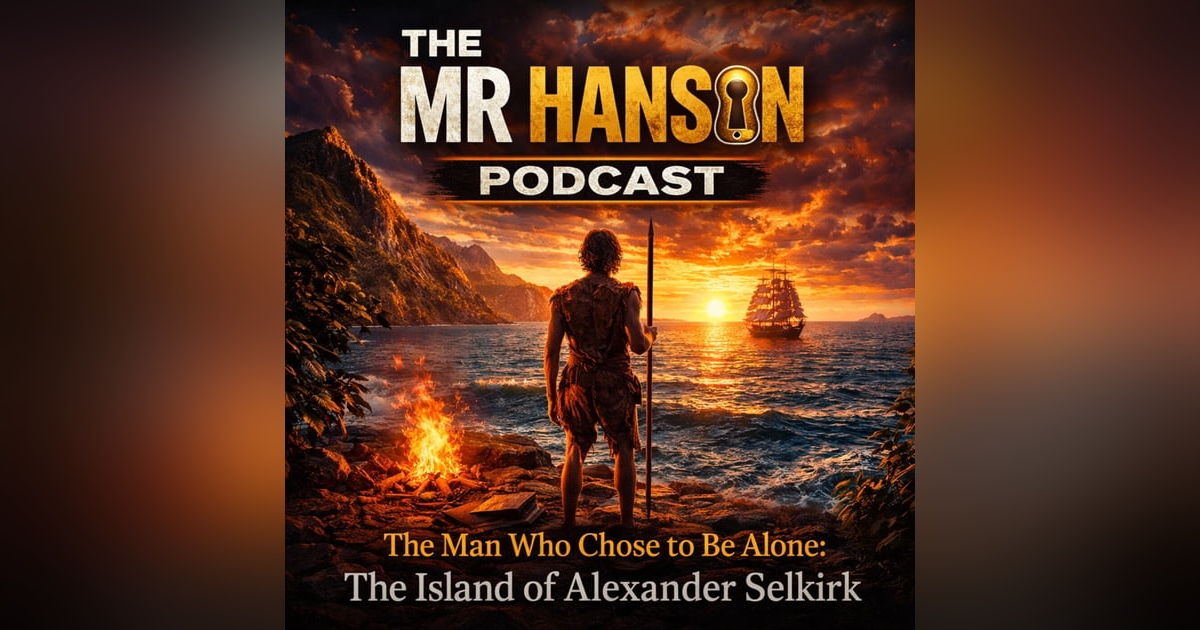


THE MR. HANSoN PODCAST "The Story of Alexander Selkirk" The Real Story Behind Robinson Crusoe
Put me ashore.
The captain did.
What followed was one of the most remarkable documented survival stories in recorded history — four years, four months, and twelve days of complete, unbroken isolation on an uninhabited island in the Juan Fernández Archipelago, four hundred miles off the coast of Chile.
No rescue came. No ship stopped. No voice broke the silence except his own.
Selkirk had to survive not just the practical challenges of the island — finding food, building shelter, staying healthy in an environment with no medical care and no margin for serious injury — but the far more dangerous challenge of surviving his own mind. Isolation, researchers now know, activates the same neural pathways as physical pain. It produces hallucination, paranoia, and cognitive deterioration. It is, in the truest sense, a threat to the self.
Selkirk broke. Then he rebuilt.
He ran the island's hills barefoot until he could outpace the feral goats he hunted. He tamed hundreds of cats to keep the rats from his shelters. He constructed two huts from local timber, fashioned clothing from goatskins, and read his Bible until the words were memorized. He sang hymns into the dark because the alternative was silence and the silence had a weight he couldn't afford.
When a rescue ship finally arrived in 1709, the men who found him on the beach struggled to reconcile what they saw with what they had expected. He was lean, fast, wild-eyed, and almost impossibly fit — and deeply changed in ways that four years of English civilization could not entirely reverse.
His story inspired Daniel Defoe's Robinson Crusoe. But Crusoe is a fantasy of mastery. Selkirk's story is something far more uncomfortable: a true account of what total freedom actually feels like from the inside, and what it costs.
In this episode, MR. HANSoN traces the full arc — from a difficult boyhood in coastal Scotland, through the privateer world of the early 1700s, through the argument that changed everything, and into the island years that remade a man.
He was right about the ship, by the way.
It sank.
- Alexander Selkirk podcast
- Robinson Crusoe real story
- castaway survival story
- MR. HANSoN podcast
- survival isolation history
- true history podcast
- Scottish explorer podcast
- Pacific island survival
- who was Alexander Selkirk and what happened to him
- the real story behind Robinson Crusoe podcast
- what happened to the Cinque Ports after Selkirk was left behind
- true survival stories podcast cinematic storytelling
- how did Alexander Selkirk survive alone on an island
- best narrative history podcasts Paul Harvey style
- psychology of isolation and survival historical stories
- was Robinson Crusoe based on a real person
- Alexander Selkirk Juan Fernández Islands 1704
- prestige storytelling podcast similar to Wondery and HBO
Who was Alexander Selkirk? A: Alexander Selkirk was a Scottish privateer born in 1676 who became the inspiration for Daniel Defoe's Robinson Crusoe. In 1704, he voluntarily demanded to be put ashore on an uninhabited island in the South Pacific after declaring his ship — the Cinque Ports — structurally unsafe. He survived alone on the island for four years and four months before being rescued in 1709.
Was Robinson Crusoe based on a real person? A: Yes. Robinson Crusoe, published by Daniel Defoe in 1719, is widely believed to have been inspired by the true story of Alexander Selkirk, a Scottish sailor who lived alone on an uninhabited Pacific island from 1704 to 1709. Defoe never publicly acknowledged the connection, but the parallels between Selkirk's documented experience and Crusoe's fictional one are extensive and well-documented by historians.
What island did Alexander Selkirk live on? A: Selkirk was marooned on Más a Tierra, an island in the Juan Fernández Archipelago located approximately 400 miles off the coast of Chile in the South Pacific. The island was later renamed Robinson Crusoe Island in 1966, in recognition of its connection to Defoe's novel.
Why did Alexander Selkirk ask to be left on the island? A: Selkirk was serving as boatswain on a privateer vessel called the Cinque Ports when he became convinced the ship's hull was dangerously rotted and unfit for continued sailing. After an escalating argument with Captain Thomas Stradling, Selkirk demanded to be put ashore rather than continue on a ship he believed would not survive the voyage. He expected the ultimatum to force a compromise. The captain took him at his word and left him on the island.
What happened to the Cinque Ports after Selkirk was left behind? A: The Cinque Ports sank — validating Selkirk's structural concerns exactly. The ship was lost in the South Pacific, and Captain Stradling along with surviving crew members were captured by the Spanish and spent years in captivity. Selkirk's refusal to remain aboard the ship almost certainly saved his life, though at the cost of over four years of solitary existence on the island.
How did Alexander Selkirk survive alone on the island? A: Selkirk survived through a combination of practical skill, psychological adaptation, and resilience. He hunted feral goats — eventually catching over five hundred — built two huts from local timber, fashioned clothing from goatskins, identified edible plants and freshwater sources, and tamed feral cats to protect his food stores from rats. He also maintained psychological stability through daily Bible reading, prayer, and singing, which historians believe were critical to his mental survival through the most severe periods of isolation.
Who rescued Alexander Selkirk from the island? A: Selkirk was rescued on February 2, 1709, by a British privateer expedition commanded by Captain Woodes Rogers. Rogers later published a detailed account of finding Selkirk on the beach — describing a man in goatskin clothing, deeply changed by years of isolation but physically vigorous beyond what the rescuers expected.
What happened to Alexander Selkirk after he was rescued? A: After his return to England in 1711, Selkirk became briefly famous and was interviewed by journalist Richard Steele, whose published account helped inspire Defoe's Robinson Crusoe. However, Selkirk struggled to reintegrate into English society after years of isolation and reportedly spent time alone in a cave he built in his family's garden. He returned to sea and died in 1721 at age forty-five aboard a ship off the coast of West Africa.
Alexander Selkirk, Robinson Crusoe, castaway, Pacific island survival, privateers, Cinque Ports, Woodes Rogers, Daniel Defoe, 18th century history, survival psychology, isolation, Scottish history, Juan Fernández Islands, maritime history, narrative history podcast, MR. HANSoN, true history, cinematic storytelling, prestige podcast, Paul Harvey style, survival stories
- "He stood on the deck, looked his captain in the eye, and said: Put me ashore. And the captain… put him ashore."
- "He was right about the ship, by the way. It sank."
- "Freedom — genuine freedom, total freedom — is not restful. It does not feel like an exhale. It feels, at least at first, like falling."
- "He stopped waiting to be rescued. And started learning to live. That is the pivot on which his entire story turns."
- "What remains when everything is stripped away? The answer is both simpler and harder than the question suggests. What remains is you."
00:00 — Cold Open: The Decision That Split a Life 05:30 — Act I: The Man Who Wouldn't Listen (Lower Largo, Scotland) 11:00 — Act II: The World He Sailed Into (Privateers of the 1700s) 17:00 — Act III: The Argument (The Cinque Ports) 22:30 — Act IV: The Weight of Silence (Arrival on the Island) 27:30 — Act V: The Breaking (The First Year) 33:00 — Act VI: The Long Becoming (Survival and Adaptation) 38:30 — Act VII: What the Island Made (The Transformation) 42:00 — Act VIII: The Ship (Rescue, 1709) 44:30 — Act IX: The Truth About Being Right (The Cinque Ports Sinks) 46:00 — Act X: The Story That Wasn't His (Robinson Crusoe and Defoe) 48:00 — Final Act: The Cost of Freedom 50:00 — Signature Close
SERIES POSITIONING STATEMENT
This episode represents the core of the MR. HANSoN standard: a true story, told with cinematic precision, that arrives at something universal. The Alexander Selkirk episode belongs in the same tier as the show's benchmark episodes — a flagship piece that demonstrates what prestige narrative history audio sounds and feels like when executed without compromise. Recommended for new listener introduction and sponsor showcase placement.
www.MRHANSoNpodcast.com
See Privacy Policy at https://art19.com/privacy and California Privacy Notice at https://art19.com/privacy#do-not-sell-my-info.


