S E10: The Signal They Ignored: How Hedy Lamarr Invented the Technology Behind Wi-Fi, Bluetooth, and GPS — and Was Never Paid a Dollar
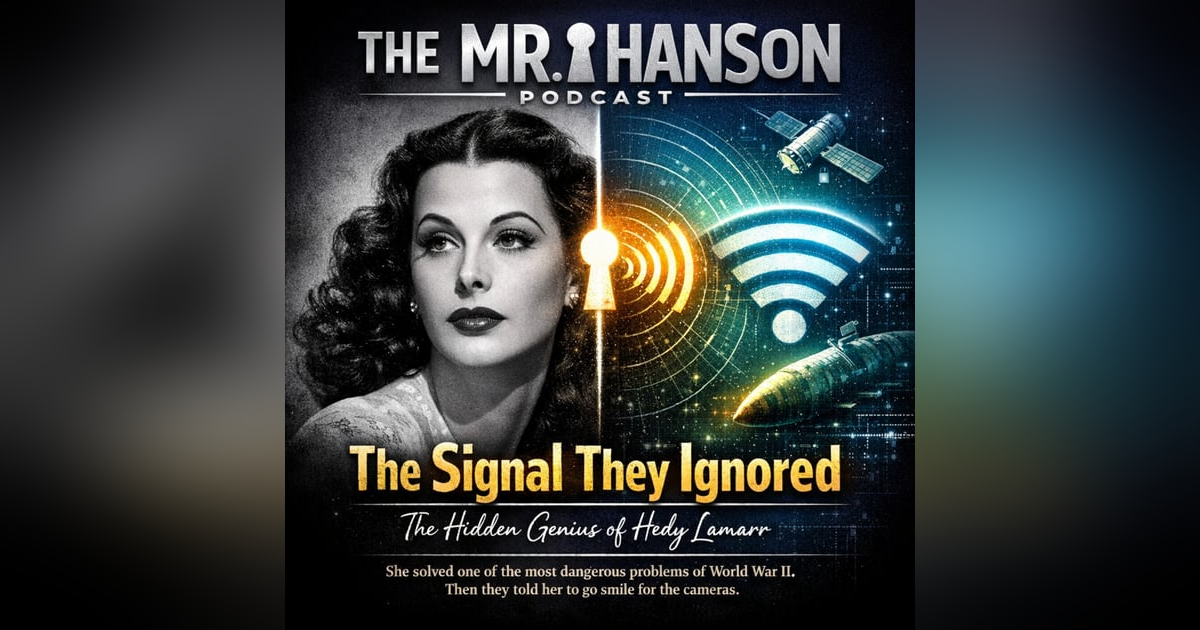


There are signals moving through the air around you right now. Carrying voices, messages, data — your entire connected world riding on invisible frequencies at the speed of light. Your phone. Your wireless headphones. Your navigation system. The Wi-Fi router humming in the background of every room in your house.
Behind all of it is a system. Behind that system is an idea. And behind that idea is a woman the world decided was too beautiful to be taken seriously.
Hedy Lamarr was born Hedwig Kiesler in Vienna in 1914. Her father — a banker with an engineer's curiosity — taught her to look beneath the surface of things. To understand systems. To ask how mechanisms worked and where they failed. That habit of mind would eventually change the world.
But the world saw something else first.
European cinema called her the most beautiful woman in the world. At nineteen she married Friedrich Mandl — an Austrian arms manufacturer whose dinner parties were attended by military officers, weapons designers, and government officials who spoke freely about torpedo guidance systems, signal vulnerabilities, and the specific technical failures that were costing lives. They assumed she didn't understand a word.
She understood everything.
When she eventually escaped that marriage and made her way to Hollywood — signed by MGM, positioned as a star, reduced to her face by an industry that specialized in reduction — she went home every night to a drafting table. While the world watched her perform, she was working on the problem she couldn't stop thinking about. What if the signal didn't stay still? What if it moved — frequency by frequency, too fast to track, too precise to jam?
She found a collaborator in avant-garde composer George Antheil, whose experimental work with synchronized player pianos gave them both the mechanical model they needed. In 1942 they were granted U.S. Patent 2,292,387 — a frequency-hopping spread spectrum communication system designed to protect radio-guided torpedoes from enemy jamming.
They brought it to the U.S. Navy.
The Navy told them it was too complex. That the technology wasn't there yet. That she could contribute more usefully by selling war bonds.
She did. She raised tens of millions. And the patent sat on a shelf.
It expired in 1959. Unimplemented. Uncompensated.
By the late 1950s and 1960s, military engineers were independently arriving at the same conclusion she had reached in 1942. The Cold War had made secure wireless communication existential — not just useful, but necessary for civilization's survival. Frequency-hopping spread spectrum was classified, deployed, and never attributed to anyone by name.
And then it became everything.
Bluetooth. Wi-Fi. GPS. CDMA cellular architecture. The foundational technology beneath nearly every wireless communication system on the planet. All of it tracing its roots — directly, architecturally — to a patent filed by a Hollywood actress and a composer of experimental music, ignored by the people who needed it most, and left to expire without a word of acknowledgment.
In 1997, the Electronic Frontier Foundation gave Hedy Lamarr its Pioneer Award. She was eighty-two years old. She couldn't attend the ceremony. They reached her by phone.
Her response: It's about time.
In this episode of The MR. HANSoN Podcast, we tell the full story — from the walks through Vienna with her father, to the dinner parties of Friedrich Mandl, to the drafting table in Hollywood, to the Navy meeting, to the fifty-year wait, to the moment the world finally caught up with a woman it had never bothered to look at twice.
The signal was always there.
It was just waiting to be understood.
The MR. HANSoN Podcast — Fuzzy Life Entertainment www.mrhansonpodcast.com
- Hedy Lamarr
- Hedy Lamarr inventor
- Wi-Fi history
- Bluetooth inventor
- spread spectrum
- frequency hopping
- WWII technology
- forgotten inventors
- women in STEM history
- Hedy Lamarr patent
- secret communication system
- George Antheil
- Hollywood inventors
- GPS origin
- radio jamming WWII
- overlooked inventors
- Hedy Lamarr biography
- wireless communication history
- World War II innovation
- MR. HANSoN Podcast
- who invented Wi-Fi and Bluetooth technology
- Hedy Lamarr frequency hopping patent explained
- what did Hedy Lamarr invent during World War II
- how spread spectrum technology was invented
- why did the US Navy ignore Hedy Lamarr
- Hedy Lamarr and George Antheil invention story
- Hollywood actress who invented wireless technology
- most overlooked inventor of the twentieth century
- Hedy Lamarr patent 2292387 history
- how Wi-Fi was invented World War II connection
- what is frequency hopping spread spectrum
- forgotten women inventors of the 20th century
- did Hedy Lamarr get paid for her invention
- Hedy Lamarr Pioneer Award Electronic Frontier Foundation
- Friedrich Mandl arms dealer Hedy Lamarr marriage
- history of Bluetooth and its surprising origins
- secret communication system WWII torpedo guidance
- how the Cold War used frequency hopping technology
- Hedy Lamarr escape from Austria story
- cinematic history podcast MR. HANSoN
- best history podcasts about overlooked geniuses
- women inventors ignored by history podcast
- Hedy Lamarr biography podcast episode
- how your phone connects to Wi-Fi invention history
- what technology did Hedy Lamarr actually invent
What did Hedy Lamarr invent? A: Hedy Lamarr co-invented a frequency-hopping spread spectrum communication system in 1942, alongside composer George Antheil. Originally designed to protect Allied radio-guided torpedoes from enemy jamming during World War II, the technology became the foundational principle behind modern Bluetooth, Wi-Fi, GPS, and secure military communications. She and Antheil were granted U.S. Patent 2,292,387, but the patent expired in 1959 before the technology was adopted. She received no financial compensation.
Did Hedy Lamarr invent Wi-Fi or Bluetooth? A: Hedy Lamarr did not directly invent Wi-Fi or Bluetooth, but her 1942 patent for frequency-hopping spread spectrum communication established the foundational principle that both technologies rely on. Engineers building modern wireless protocols in the 1980s and 1990s developed Wi-Fi and Bluetooth using spread spectrum techniques that trace directly to the concept she and George Antheil patented during World War II.
Why did the US Navy reject Hedy Lamarr's invention? A: The U.S. Navy rejected Hedy Lamarr's frequency-hopping patent in 1942 citing technical complexity and the lack of miniaturized electronics needed for practical implementation. However, historians note that the dismissal also reflected institutional bias — the Navy had difficulty accepting a weapons technology innovation from a Hollywood actress. She was redirected to selling war bonds. The technology was not implemented until the late 1950s and 1960s, after her patent had already expired uncompensated.
How did Hedy Lamarr learn about torpedo guidance systems? A: Hedy Lamarr gained detailed knowledge of torpedo guidance vulnerabilities through her first marriage to Austrian arms manufacturer Friedrich Mandl. Mandl hosted lavish dinner parties attended by military officers, weapons engineers, and government officials who discussed classified weapons technology openly in her presence, assuming she did not understand the technical content. She listened carefully and retained the information, later using it as the foundation for her frequency-hopping invention.
Did Hedy Lamarr receive recognition for her invention? A: Recognition came late. In 1997 — fifty-five years after filing the patent — Hedy Lamarr received the Pioneer Award from the Electronic Frontier Foundation. She was eighty-two years old and unable to attend the ceremony. She received the news by phone. Her patent had already expired in 1959, and she received no financial compensation from any of the technologies built on her foundational concept.
What is frequency-hopping spread spectrum? A: Frequency-hopping spread spectrum is a communication method in which a signal rapidly switches between multiple frequencies in a coordinated sequence known to both the transmitter and receiver. This makes the signal extremely difficult to intercept or jam, because an adversary cannot lock onto a single fixed frequency. Hedy Lamarr and George Antheil patented an early version of this concept in 1942. It is now used in Bluetooth, Wi-Fi, GPS, and secure military communication systems worldwide.
CHAPTER TIMESTAMPS
00:00 — Cold Open: The signals all around you 03:10 — Act I: Vienna, 1914 — the world that built her 10:45 — Act II: The most beautiful woman in the world 17:20 — Act III: Friedrich Mandl's dinner parties 26:00 — Act IV: The drafting table in Hollywood 33:40 — Act V: The Navy meeting — and the shelf 39:15 — Act VI: The Cold War catches up 44:50 — Act VII: The rest of the story
- Primary title: The Signal They Ignored: The Hidden Genius of Hedy Lamarr
- Subtitle (160 char): Hollywood called her the most beautiful woman alive. She was also the inventor behind Wi-Fi, Bluetooth, and GPS. Nobody noticed for 50 years.
- First paragraph of description must contain "Hedy Lamarr," "frequency hopping," and "Wi-Fi" for category indexing
- Title targets: "Hedy Lamarr inventor" and "who invented Bluetooth" discovery queries
- Description front-loads "Hedy Lamarr," "invented," and "Wi-Fi" within the first 100 characters
- Tag clusters: History, True History, Science & Technology, Women in History, WWII, Innovation
- Title format: She Invented Wi-Fi During WWII. Nobody Listened. | Hedy Lamarr | MR. HANSoN Podcast
- Thumbnail direction: Split image — vintage Hollywood portrait of Lamarr / close-up of wireless signal wave graphic
- First 150 characters of description: Hedy Lamarr invented the technology behind Wi-Fi, Bluetooth, and GPS during World War II. The U.S. Navy ignored her. Her patent expired uncompensated.
- Pin a comment with chapter timestamps at upload
- Primary target: "what did Hedy Lamarr invent"
- Secondary target: "did Hedy Lamarr invent Wi-Fi"
- Tertiary: "who invented Bluetooth and Wi-Fi"
- Use AEO answer blocks verbatim in episode show notes for featured snippet eligibility
- Structured FAQ section in show notes increases AI citation probability significantly for this topic
She sat at her first husband's dinner parties surrounded by weapons engineers who thought she was just the pretty wife. She was memorizing everything they said. The story of Hedy Lamarr — and the idea behind your Wi-Fi — is on The MR. HANSoN Podcast now.
The U.S. Navy ignored her invention in 1942. Her patent expired uncompensated in 1959. Then the world built itself on top of her idea. Wi-Fi. Bluetooth. GPS. Every wireless device you own. Hedy Lamarr's full story — this week on The MR. HANSoN Podcast. Link in bio.
She solved one of the most dangerous problems of World War II from a drafting table in Hollywood. Then they told her to sell war bonds. The Signal They Ignored — Hedy Lamarr — on The MR. HANSoN Podcast.
The MR. HANSoN Podcast exists to tell the stories history keeps misfiling. Hedy Lamarr was not a footnote. She was not a curiosity. She was an architect — a person whose mind produced something so far ahead of its moment that the world needed fifty years to catch up, and never properly acknowledged that it had. This episode belongs in the permanent catalog alongside every story that asks the question institutions are always afraid to answer: what if the person we dismissed was the one we needed most?
www.MRHANSoNpodcast.com
See Privacy Policy at https://art19.com/privacy and California Privacy Notice at https://art19.com/privacy#do-not-sell-my-info.


